
Rare-earth buyers are trading processing expertise for future supply
Sub-Saharan Africa — South Africa, with Kazakhstan, Estonia and France as processing counterparts
Share ↗
The signal
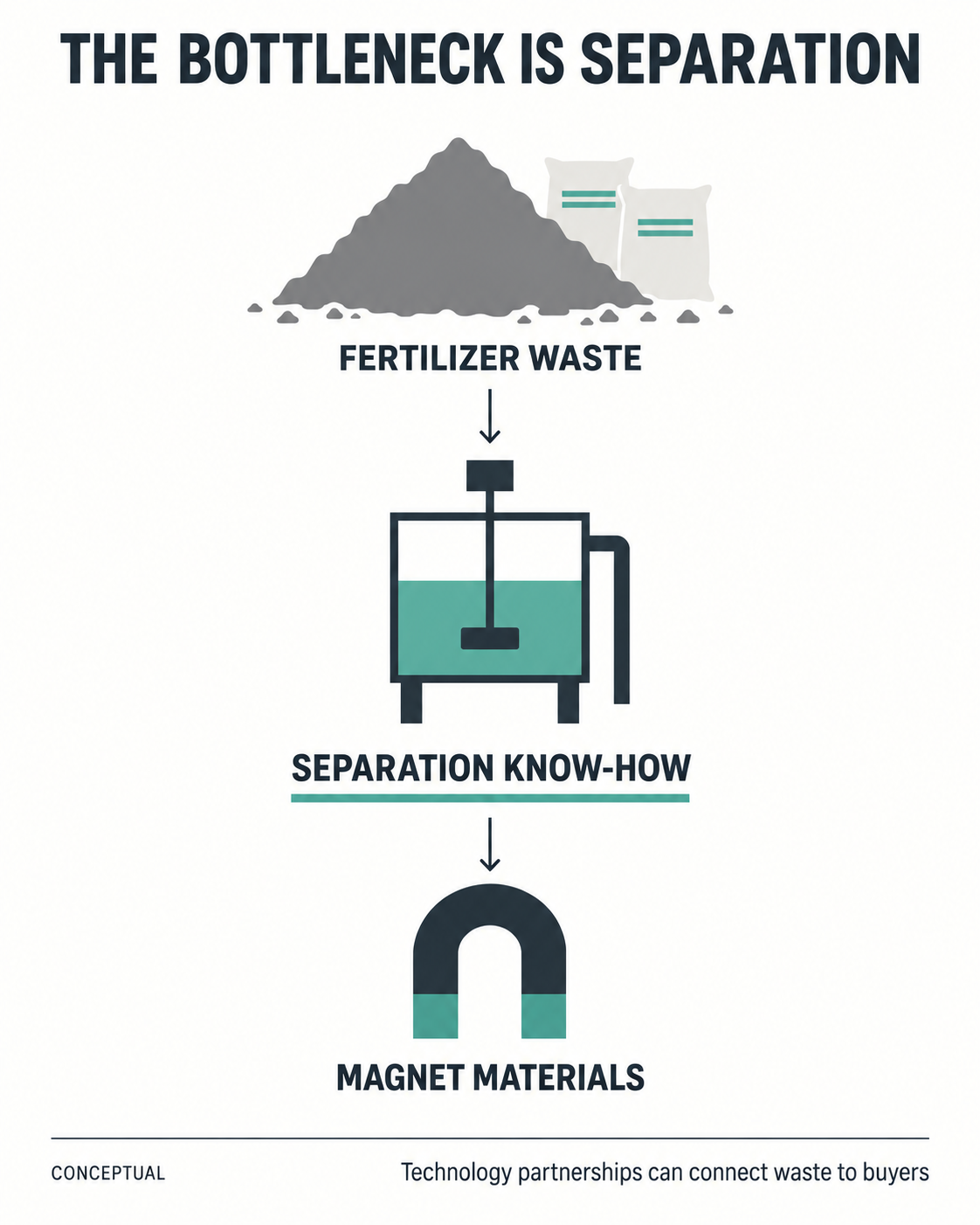
Technical testwork and technology-for-offtake partnerships suggest separation expertise and product qualification, rather than resource access alone, are an emerging commercial bottleneck. Neo/Rainbow remains a nonbinding MOU; Lindian/Carester supplies an independent analogous binding partnership, not validation of production economics.
Why this one
Two separate partnerships expose a useful early commercial pattern: processing knowledge is being exchanged for future supply, before production economics are established.
The clue
Processing expertise is becoming part of the purchase agreement—not merely something a resource developer must obtain before finding a buyer.
Why it matters
For equipment manufacturers, a promising mineral resource is not the same as a qualified materials supplier. Separation expertise, customer qualification and enforceable purchase arrangements may deserve as much attention as extraction capacity.
Evidence and interpretation
- Observed facts: On September 24, Rainbow and Neo announced a nonbinding agreement connecting South Africa’s Phalaborwa fertilizer-waste recovery project with Neo’s separation expertise and proposed future purchases. Feed-material testing is underway in Estonia; definitive agreements remain to be negotiated. Separately, Lindian announced a binding engineering-and-purchase partnership with Carester on September 3 for a planned Kazakhstan separation facility. These are company disclosures, not independent proof of production economics. - Interpretation: Different feedstocks and countries show a similar commercial response: buyers help develop processing capacity in exchange for future supply. Conventional mining and third-party refining remain alternatives; the evidence does not establish that waste recovery is cheaper. - Speculation: If these projects qualify reliable products, opportunities could grow for separation equipment, testing and processing services alongside resource development.
What to watch next
Integrated pilot results, qualified customer samples and definitive Rainbow/Neo agreements would strengthen the thesis. Poor purity or yield, uneconomic waste treatment, failed agreements or delayed feasibility work would weaken it.