
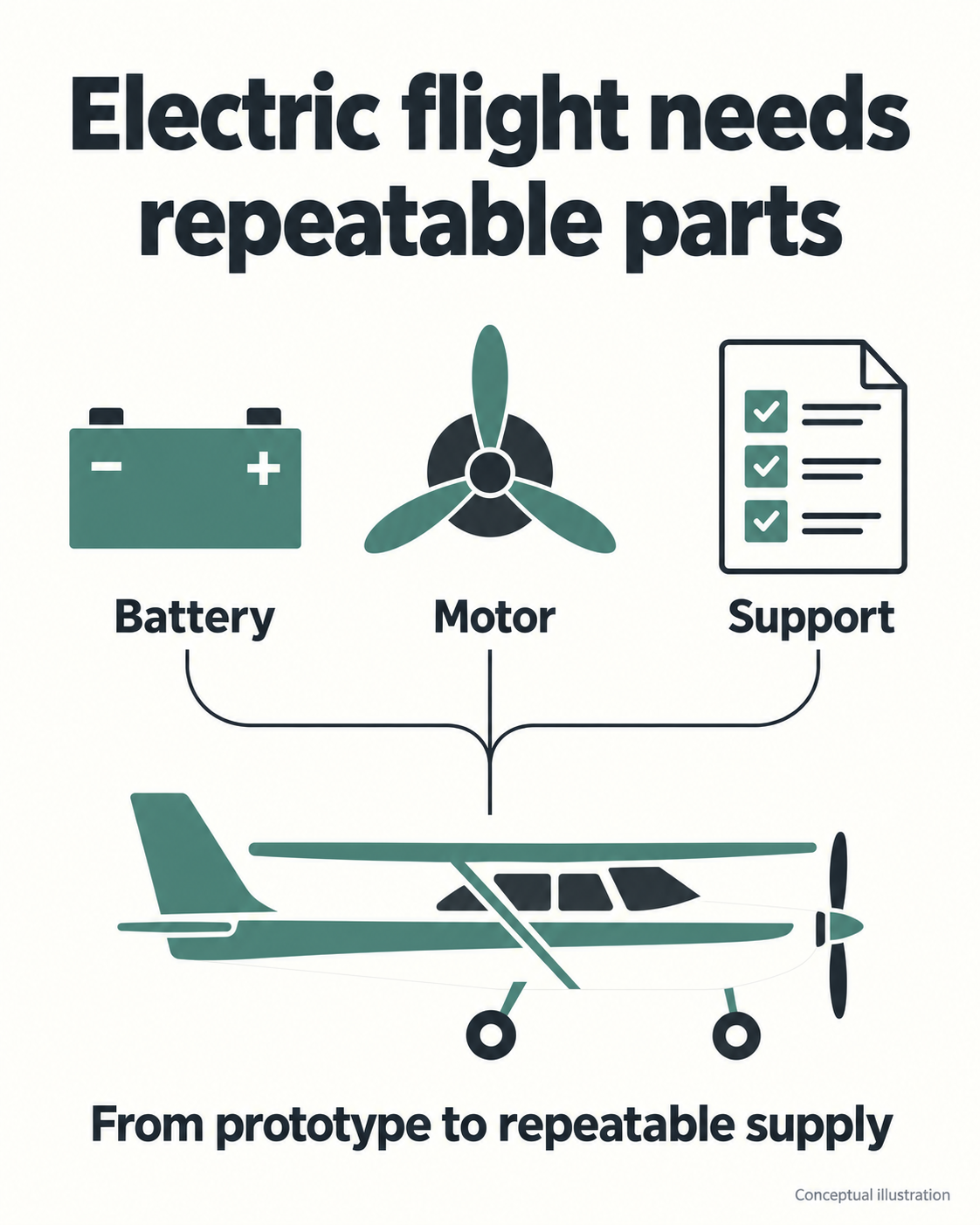
Electric aviation starts buying repeatable propulsion components
Europe — France and Switzerland; aircraft programs in Czechia, the United States and Canada
Share ↗
The signal
Flight-test activity, a separate motor supply agreement and delivered battery modules suggest an emerging market for reusable propulsion components and integration services. These supplier reports do not prove aircraft-level certification, economic fleet operation or interchangeable hardware.
The clue
Flight testing, a motor supply agreement, and battery deliveries suggest a component market forming beneath electric-aircraft development.
Why it matters
The opportunity may extend beyond aircraft manufacturers to battery screening, power-system integration, maintenance and production-quality services.
Evidence and interpretation
- Observed facts: Safran’s September 25 report describes an eFlyer 2 first flight using ENGINeUS; it does not specify the flight date. Its April 13 agreement with H55 targets Bristell’s electric trainer, with prototype and serial-production support beginning in 2027. Separately, H55 reported delivering battery modules to Pratt & Whitney Canada’s hybrid-electric demonstrator on June 9. These are supplier reports, not independent confirmation of commercial economics. Sources below. - Interpretation: The American trainer, European integration agreement and Canadian hybrid program point to a broader supplier opportunity. Battery-only training aircraft and hybrid aircraft are competing architectures, not interchangeable applications. Buying supported components could reduce duplicated engineering; continuing with conventional piston aircraft remains a credible alternative until whole-life costs are demonstrated. - Speculation: Suppliers that can reuse test evidence and support processes across customers may capture more value than one-off prototype builders. Aircraft-level qualification can still require substantial redesign.
What to watch next
Strengthen: repeat production-conforming deliveries across aircraft programs and published in-service availability, battery replacement and maintenance costs. Weaken: delayed aircraft approvals, bespoke redesign for each customer, or battery-life and turnaround costs that erase the operating advantage.