
Post-quantum security becomes an integration choice
Europe — Switzerland; international open-silicon ecosystem including the United States and Taiwan
Share ↗
The signal
ST customer sampling and Pavona's reusable engineering stack suggest a supplier layer forming around embedded post-quantum integration. These May–June clues are not proof of completed mass deployment; software-only migration remains an alternative.
Why this one
A concrete procurement question from an under-covered category, supported by distinct engineering and supplier clues. This is an early supplier-layer thesis, not a new October launch.
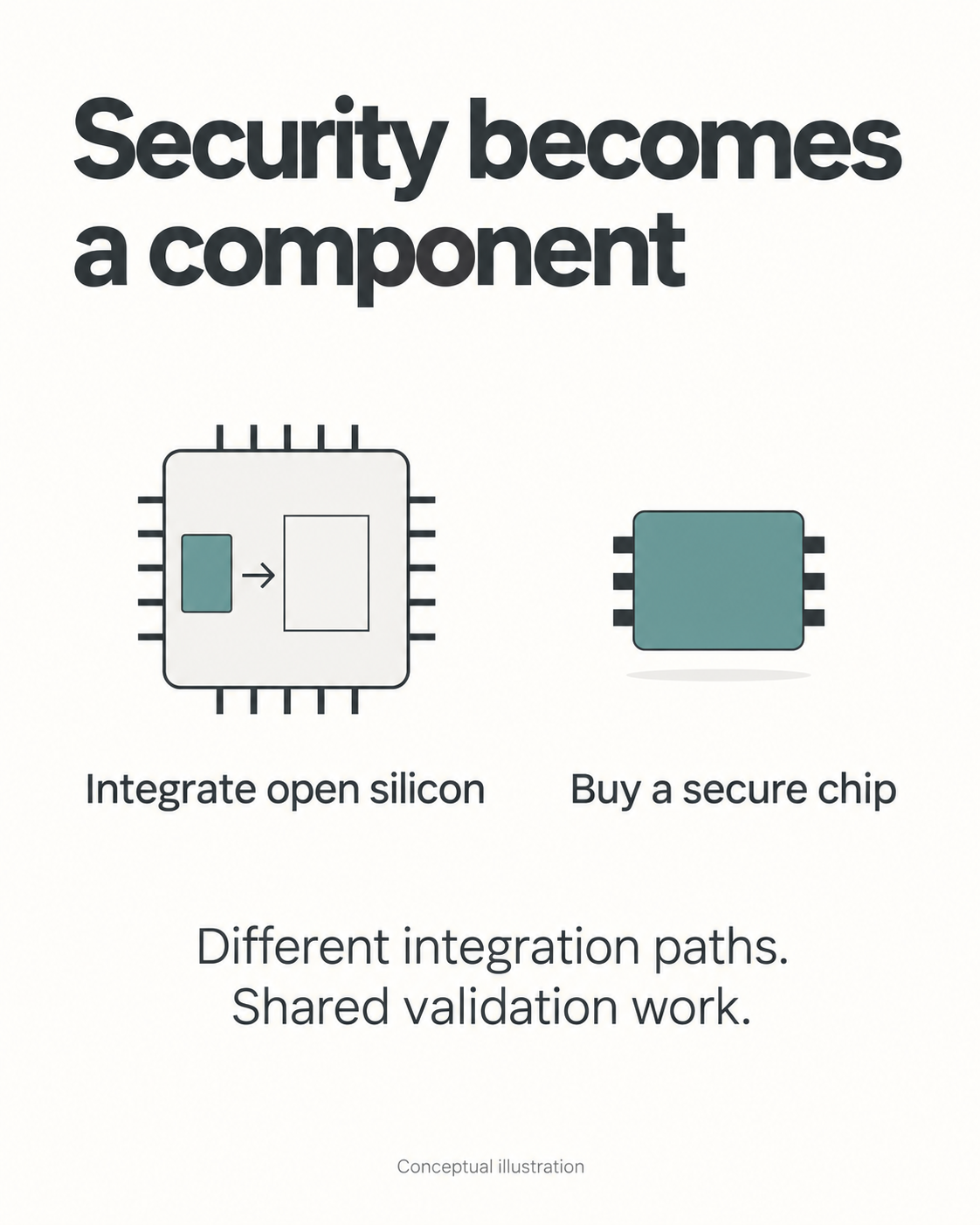
The clue
Two routes are forming around the same engineering problem: reusable chip designs and vendor-supplied secure chips.
Why it matters
For device buyers and manufacturers, procurement could shift toward implementation testing, integration support and long-term updates—not simply an algorithm checklist.
Evidence and interpretation
- Observed facts: On June 24, ST announced customer sampling of ST54M, combining post-quantum cryptographic acceleration with mobile security functions. Its July production target is not confirmation of delivery. Separately, Pavona’s May 26 launch reported completed reference-design tape-outs—the handoff of designs for fabrication—and released reusable silicon components. Its documentation specifies additional memory and hardware features for post-quantum operation. - Interpretation: Engineering details plus a separate supplier’s sampling offer support an emerging integration market. Open designs and packaged chips offer different ownership and validation trade-offs; software-only implementations remain a credible alternative. Pavona’s international collaboration, including work presented in Taiwan, makes this more than one European supplier’s roadmap. - Speculation: Integration and validation services could capture value before widespread device replacement. Neither announcement establishes that outcome.
What to watch next
Named device design wins, externally evaluated implementations and confirmed production would strengthen the thesis; prolonged sampling or software-only implementations meeting the same constraints at lower total cost would weaken the hardware opportunity.