
Robot-data sellers are building the buying process
Europe — Norway and Denmark; United States technology partner
Share ↗
The signal
Kinetic Blocks' October account of manual marketplace transactions and Universal Robots/Scale AI's March data-capture system launch suggest commercial robot data requires purchasing and validation workflows as well as capture capacity. These independent marketplace and hardware clues do not establish liquid demand or training-performance gains. On-hardware capture, simulation and external datasets remain competing approaches.
Why this one
The October operating account turns an early technology story into a practical purchasing question, while leaving the uncertainty visible.
The clue
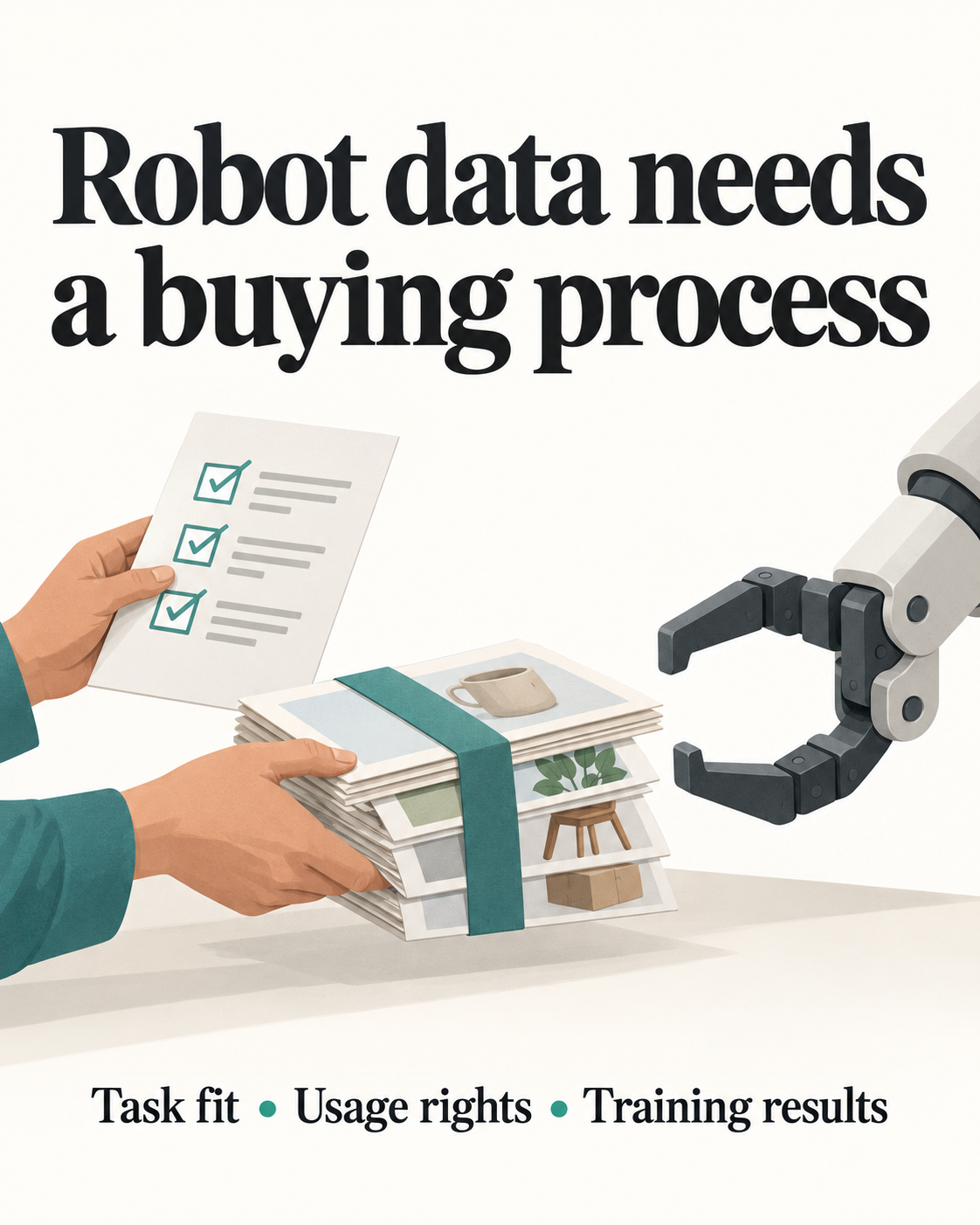
A young marketplace’s operational account exposes a gap between making robot-training data available and making it straightforward to purchase.
Why it matters
An automation team evaluating outside datasets should budget for samples, rights review and testing—not just a download. The relevant unit of value is improvement on the intended task.
Evidence and interpretation
- Observed facts: On October 8, Norway’s Kinetic Blocks reported manual transactions following its September beta launch, and acknowledged that its data-quality scores do not yet establish training usefulness. Separately, Universal Robots and Scale AI introduced a system in March that records synchronized motion, force and vision during human-guided robot demonstrations. - Interpretation: Marketplace formation and dedicated capture equipment are independent commercial and technical clues, not proof of a mature market. External purchasing competes with collecting data on the deployment hardware; the Universal Robots announcement also describes simulation-based capture. - Speculation: Sample evaluation, licensing and outcome testing could become services around robot-data exchanges. Evidence of repeat demand and measurable buyer benefit remains limited.
What to watch next
Repeat paid purchases and buyer-published tests linking external datasets to improved task performance would strengthen the thesis. No repeat buyers, unresolved rights or in-house and simulated data matching results at lower total cost would weaken it.