
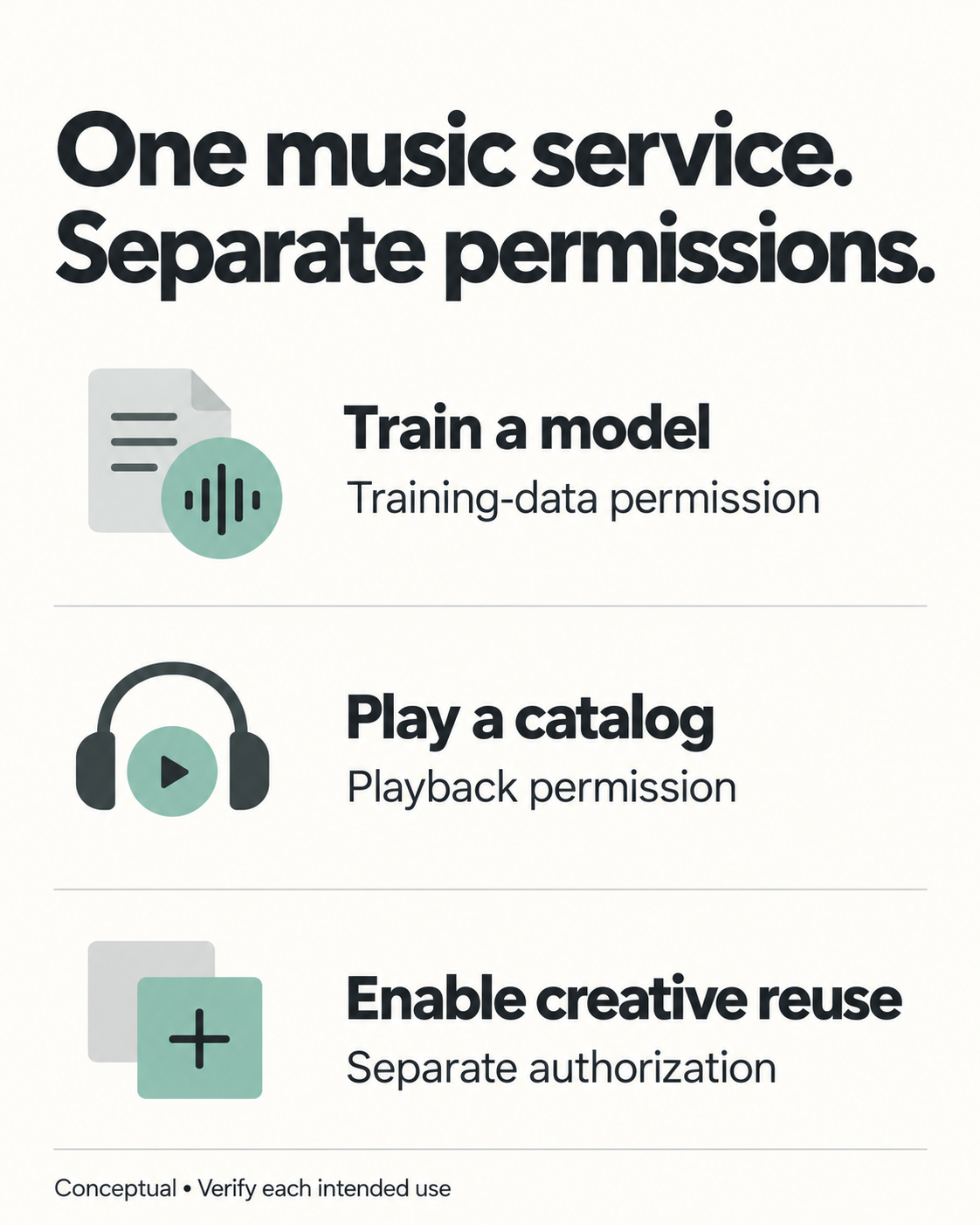
Music services assemble separate permission layers
Europe — Poland; United States counterpart and analogue
Share ↗
The signal
GRAI's October catalog-delivery and separately licensed training-data agreements, its completed Hangout acquisition and the earlier licensing of Music IP Holdings patents by both GRAI and Udio suggest a supplier opportunity around scoped permissions and usage reporting. These are distinct commercial evidence types, not independent validation of the unreleased service or blanket clearance for creative outputs.
The clue
A music startup is buying catalog delivery, training permissions and an existing social-listening business as distinct building blocks.
Why it matters
For creative-software buyers, permission scope and usage reporting could become procurement requirements alongside model quality.
Evidence and interpretation
- Observed facts: On October 15, MassiveMusic described separate catalog-delivery and opt-in training-data agreements with GRAI; the latter does not itself authorize downstream creative uses. The service was still testing. GRAI also confirms its completed acquisition of Hangout. An August 20 announcement names GRAI and Udio as Music IP Holdings patent licensees. These disclosures do not establish that every proposed use is cleared. - Interpretation: Supplier agreements, an acquisition and a second patent licensee are distinct commercialization clues. Building rights relationships internally or commissioning original music remain alternatives; the evidence does not establish which is cheaper. - Speculation: Reusable permission-management and reporting services could become a supplier opportunity before any particular music model wins.
What to watch next
Public launch with clearly documented permitted uses, repeat rightsholder participation and auditable usage reports would strengthen the thesis. Delayed launch, unusable rights restrictions, disputed reporting or lower-cost original-music workflows would weaken it.