
Rocket propulsion gains specialist integration capacity
East Asia — Japan; Spanish manufacturing analogue
Share ↗
The signal
ISC’s September electrically pumped engine test, Ebara’s component collaboration and Pangea’s independent July factory opening suggest an emerging supplier opportunity in propulsion integration and qualification. These are different architectures and company-reported evidence; ground testing and installed capacity do not establish reliable flight or production economics.
Why this one
It connects technical progress with concrete supplier investment in an under-covered category, without mistaking either for proven launch economics.
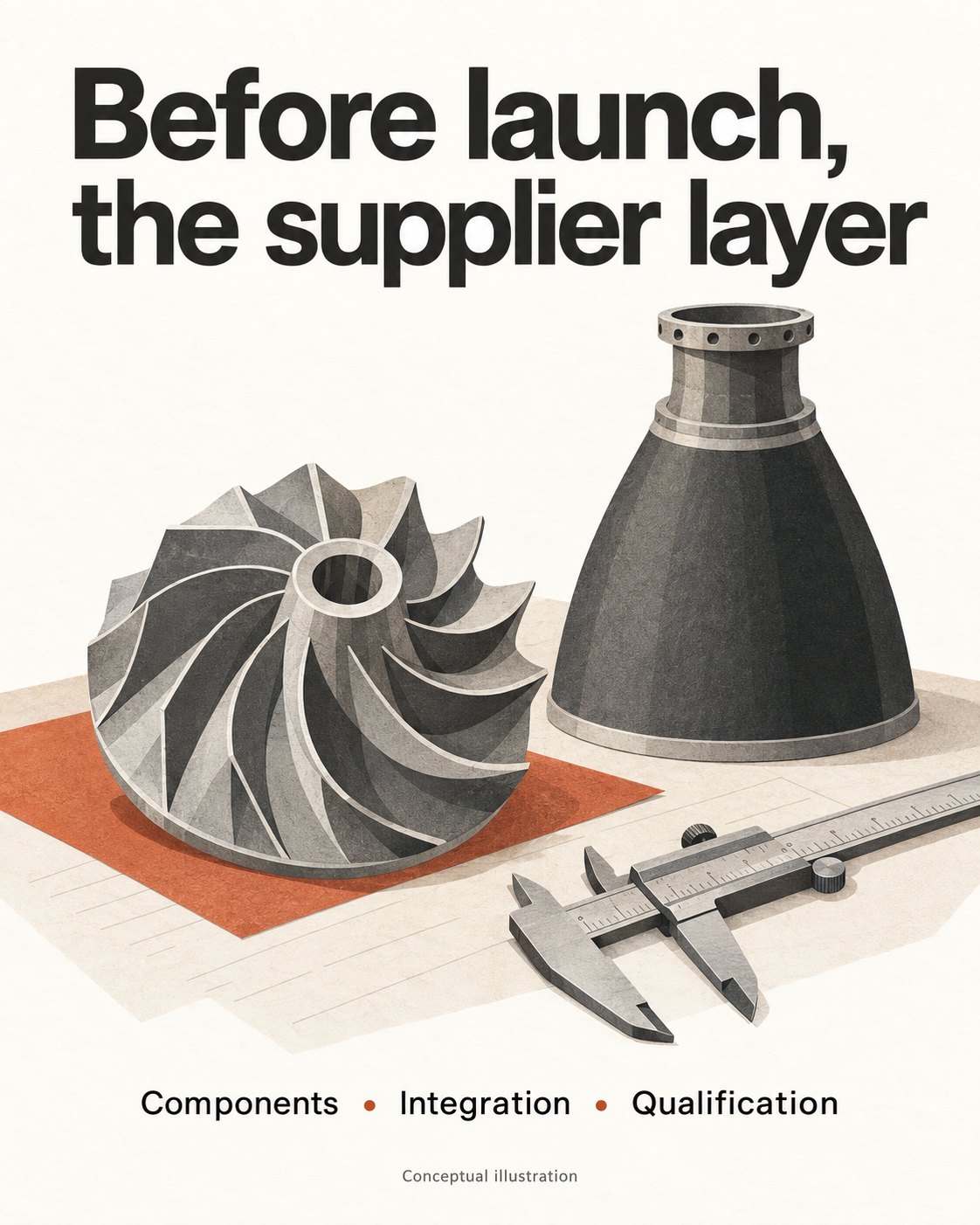
The clue
A Japanese engine test and a Spanish factory opening point to a less-visible opportunity before flight: making propulsion components work together reliably.
Why it matters
Industrial suppliers could compete for pump integration, precision manufacturing and qualification work without developing an entire launch vehicle. The horizon concerns a repeatable supplier market—not a promised launch date.
Evidence and interpretation
- Observed facts: ISC’s September 30 report describes August 27–September 9 tests reaching 60% of rated engine output with an electric pump. Ebara’s March disclosure identifies its pump collaboration with ISC. Separately, Pangea opened a Spanish integration facility on July 13, reporting €1 million already invested and a private-customer capsule integration planned. These are company-reported technical and capacity-building clues, not independent performance certification. - Interpretation: Japan’s component partnership and Spain’s integrated propulsion factory are different approaches to the same qualification burden. Buying specialist components competes with developing them internally; Pangea’s aerospike engine is not interchangeable with ISC’s design. The broader pattern is integration capacity, not a prediction that one propulsion architecture wins. - Speculation: Repeatable qualification services could become a durable supplier niche if more programs reach customer acceptance.
What to watch next
Strengthen: full-output and repeated-start tests, customer-accepted hardware and repeat private orders. Weaken: recurring redesign, failed qualification or facilities without sustained customer work.