
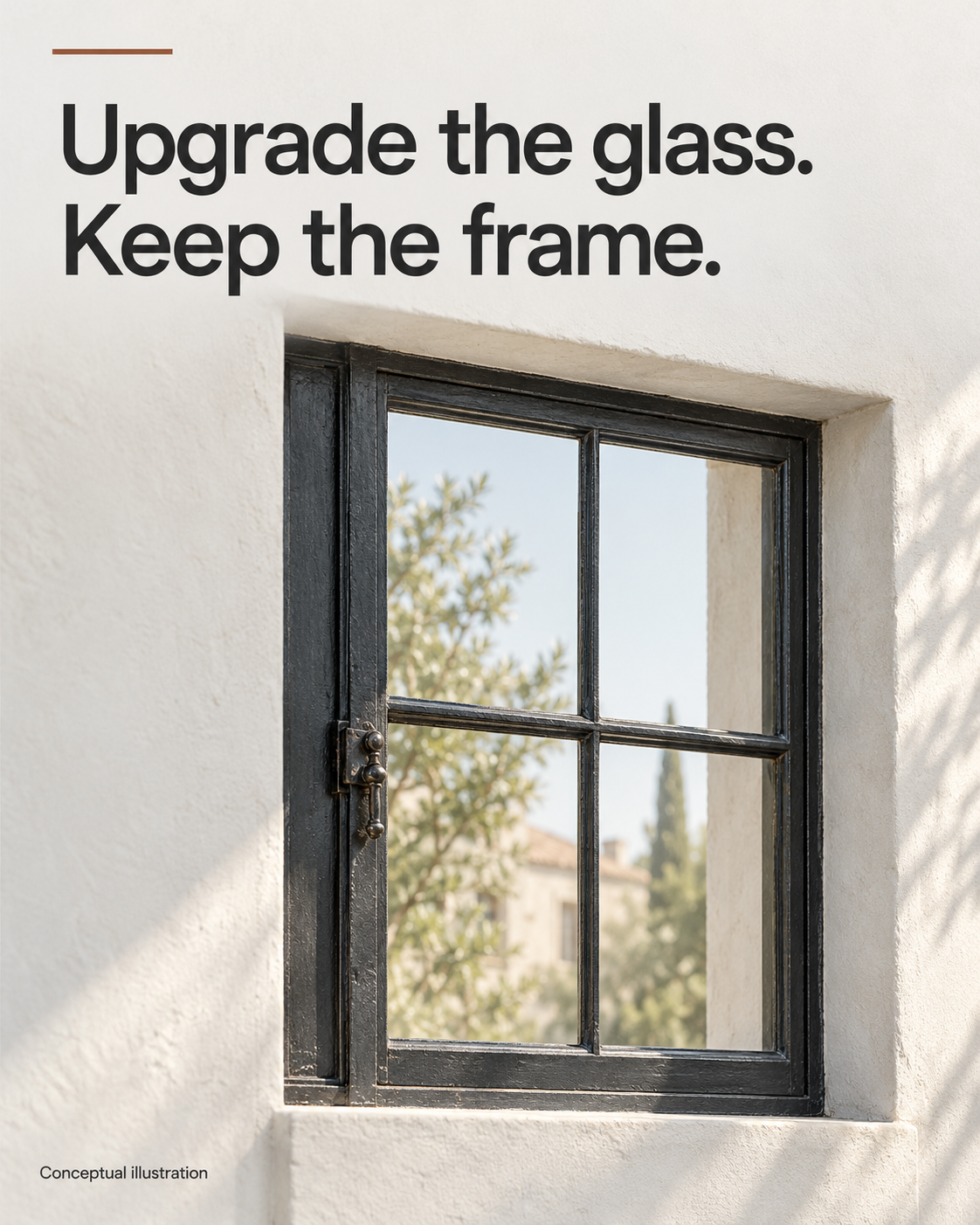
Vacuum glass expands the frame-retaining retrofit option
Europe — Belgium and France; US-market supplier analogue
Share ↗
The signal
AGC's commissioned Belgian line, a documented frame-retaining Paris renovation and Vitro/LandVac's separate product offering suggest a commercial opportunity around assessment, installation and warranty support for thin vacuum glass. The technology is established; the signal is manufacturing and retrofit delivery, not guaranteed energy savings or universal frame compatibility.
The clue
The useful development is a supply-and-installation chain, not the invention of vacuum glass.
Why it matters
Property owners can investigate whether upgrading glazing while retaining suitable frames changes renovation cost and disruption. Installers could gain work in assessment, fitting and warranty support.
Evidence and interpretation
- Observed facts: AGC announced its new Belgian FINEO production line in May 2026. Its January 2026 case study describes a Paris studio renovation completed in 2024 that retained the metal supporting structure. Separately, Vitro’s 2026 VacuMax documentation describes a LandVac-produced alternative. These are manufacturing, installation and competing-supplier clues—not independently verified building-level savings. - Interpretation: The European and US-market offerings support a broader supply pattern. Compare their different edge-seal designs and project requirements; neither establishes a universal winner over secondary glazing, conventional double/triple glazing or full-window replacement. - Speculation: A repeatable glass-only retrofit service could emerge for suitable older buildings, provided installed economics and durability hold.
What to watch next
Repeat retrofit orders, independent whole-window measurements, installed costs and seal durability would strengthen the thesis. Poor frame compatibility, persistent cost premiums or simpler secondary glazing delivering comparable outcomes would weaken it.