
Microfactories combine printing with the work that follows
North America — United States; Spanish deployment and Italian and Dutch suppliers
Share ↗
The signal
Caracol's September Freeman Boatworks selection, CEAD's earlier integrated Haddy facility and a separate Spanish shipyard installation suggest a market for localized production workflows rather than standalone printers. Technical integration, installed capacity and a named buyer commitment are distinct clues, but supplier disclosures do not establish independently verified production economics.
Why this one
A named buyer commitment and separate installations make the procurement question concrete, while the distinction between installed equipment and economical production keeps the argument appropriately cautious.
The clue
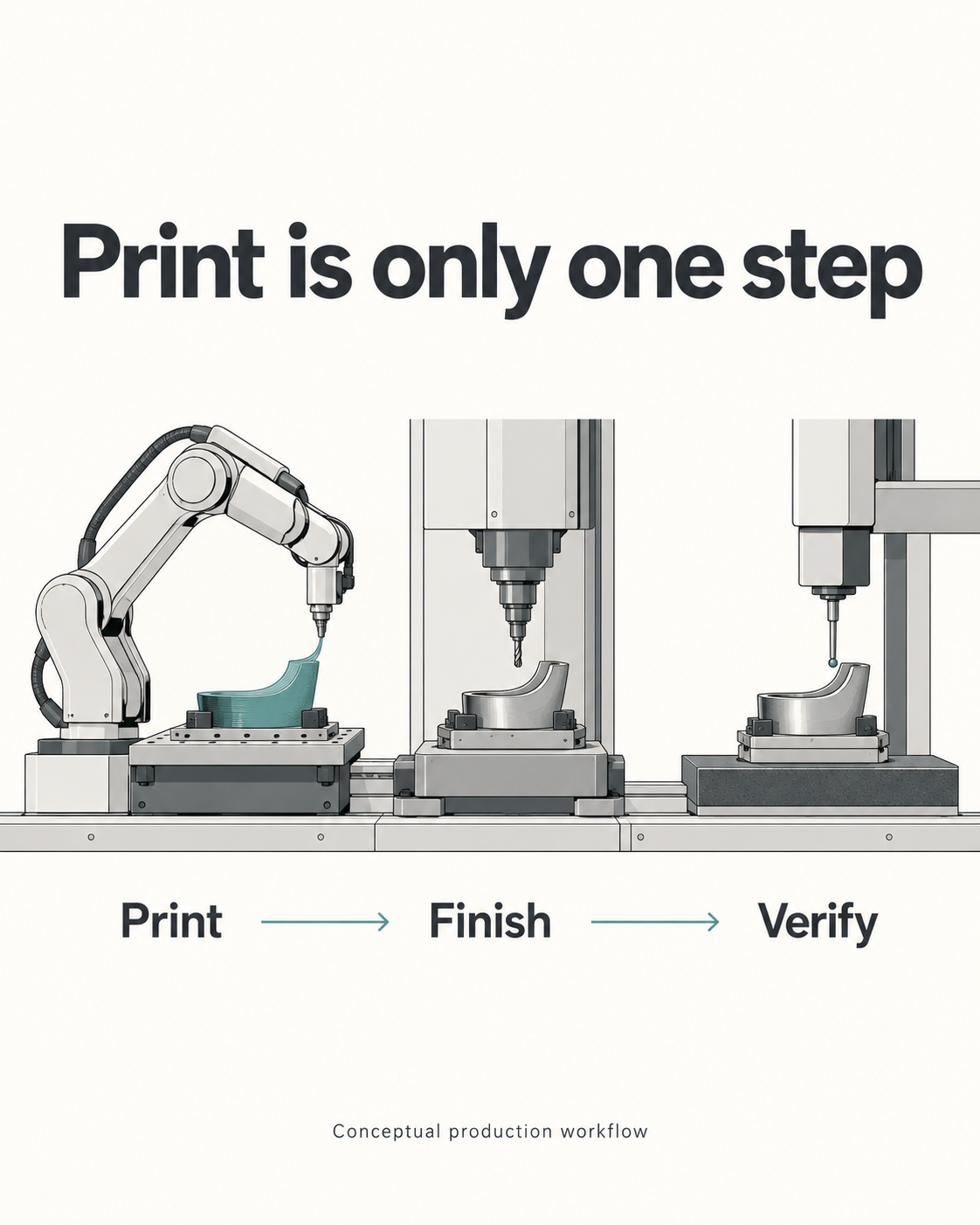
Manufacturers are selecting integrated production cells, not simply larger 3D printers.
Why it matters
For buyers, the useful comparison becomes the cost of an accepted part—including finishing, inspection and maintenance—not printing speed alone.
Evidence and interpretation
- Observed facts: In September, Caracol reported that Freeman Boatworks selected robotic printing with integrated computer-controlled machining for in-house tooling and composite parts. Separately, CEAD describes Haddy’s earlier Florida installation combining printing and machining, and reported a Spanish CULMAR shipyard installation in February. These are supplier disclosures; the older installations are context, not October launches. - Interpretation: A named procurement decision, installed capacity and integrated technical capabilities suggest a broader workflow market. Haddy’s multi-cell model and CULMAR’s shipyard integration are different implementations. Conventional molding, machining and outsourced production remain the benchmarks; these sources do not establish lower total costs. - Speculation: Local production could create additional demand for material qualification, inspection and maintenance services before it displaces centralized manufacturing at scale.
What to watch next
Repeat paid jobs, customer-accepted parts and measured all-in cost including finishing, inspection and maintenance would strengthen the thesis. Low utilization, inconsistent quality or conventional molding, machining and outsourcing matching results at lower cost would weaken it.