
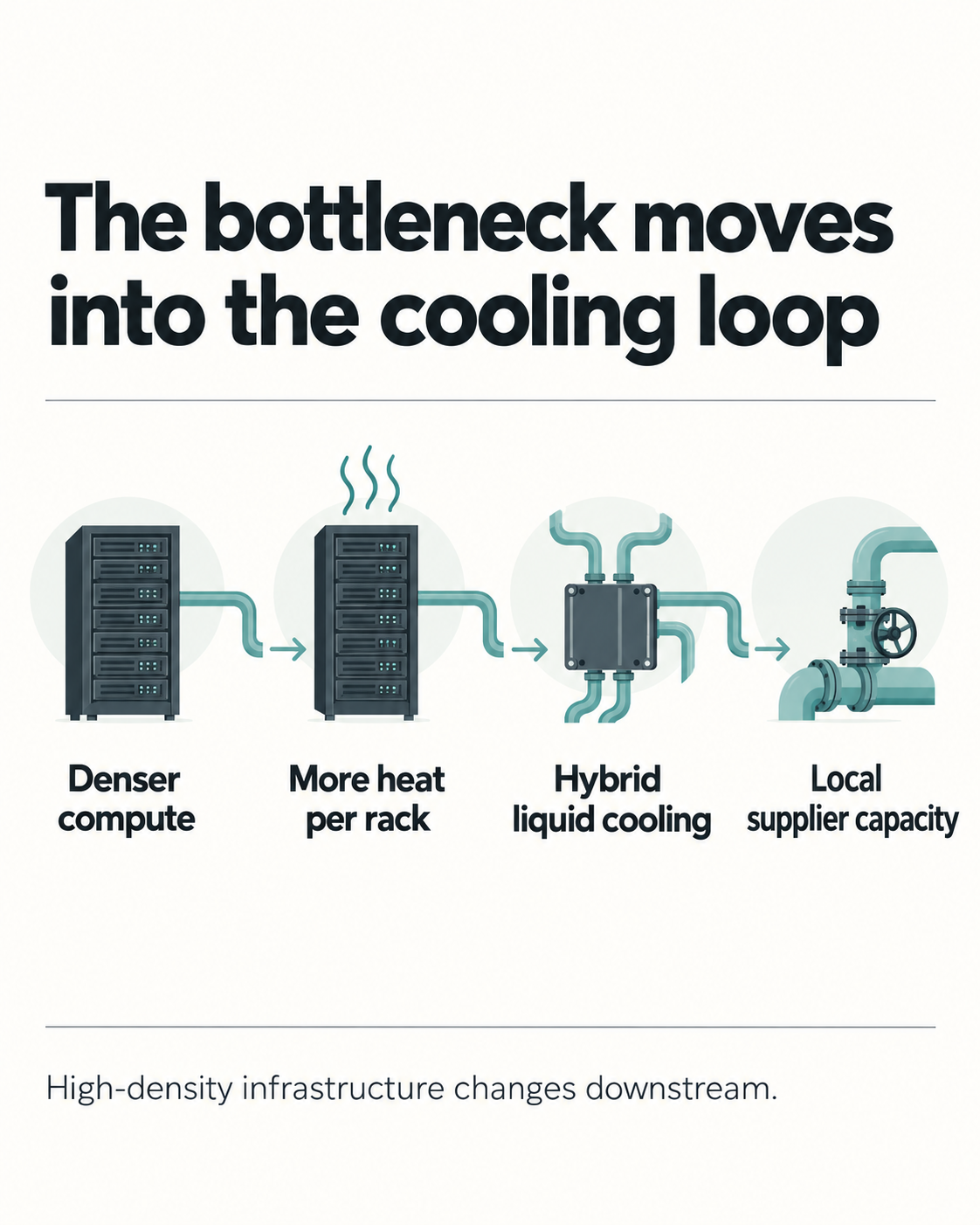
Liquid-cooling capacity is becoming a local supplier market in Latin America
Latin America & Caribbean — Brazil and Mexico, with Chile and Colombia in the supplier roadmap
Share ↗
The signal
High-density computing is turning thermal engineering from a facility detail into a procurement constraint, and ODATA's Brazil and Mexico deployments plus Munters' Brazilian manufacturing suggest the regional response is beginning to localize.
The clue
ODATA has begun installing and testing hybrid liquid cooling at data-center campuses in São Paulo and Querétaro. Munters is manufacturing the coolant-distribution units in Paraná, Brazil, for these deployments and planned regional projects.
Why it matters
High-density computing makes thermal engineering a capacity constraint, not merely a facilities detail. Enterprises may need to assess cooling architecture, equipment availability and local maintenance support when procuring compute capacity.
Evidence and interpretation
- Observed facts: The two projects’ first phase carries a combined $630 million investment. Installation and testing are underway, with air and liquid cooling supported in the same data hall. ODATA says Brazilian manufacturing will also support upcoming projects in Chile and Colombia. - Interpretation: Regional compute expansion is beginning to create a local market for specialized cooling equipment and services. - Speculation: If deployments reach commercial occupancy, coolant distribution, heat exchange, monitoring and maintenance could become a meaningful Latin American infrastructure supply chain. Air cooling, immersion cooling and relocating workloads remain credible alternatives.
What to watch next
Strengthen the thesis with commissioned liquid-cooled halls, disclosed customer occupancy, repeat equipment orders or additional regional manufacturing; weaken it if testing does not convert into operating capacity or customers remain able to meet density needs with air cooling alone.