
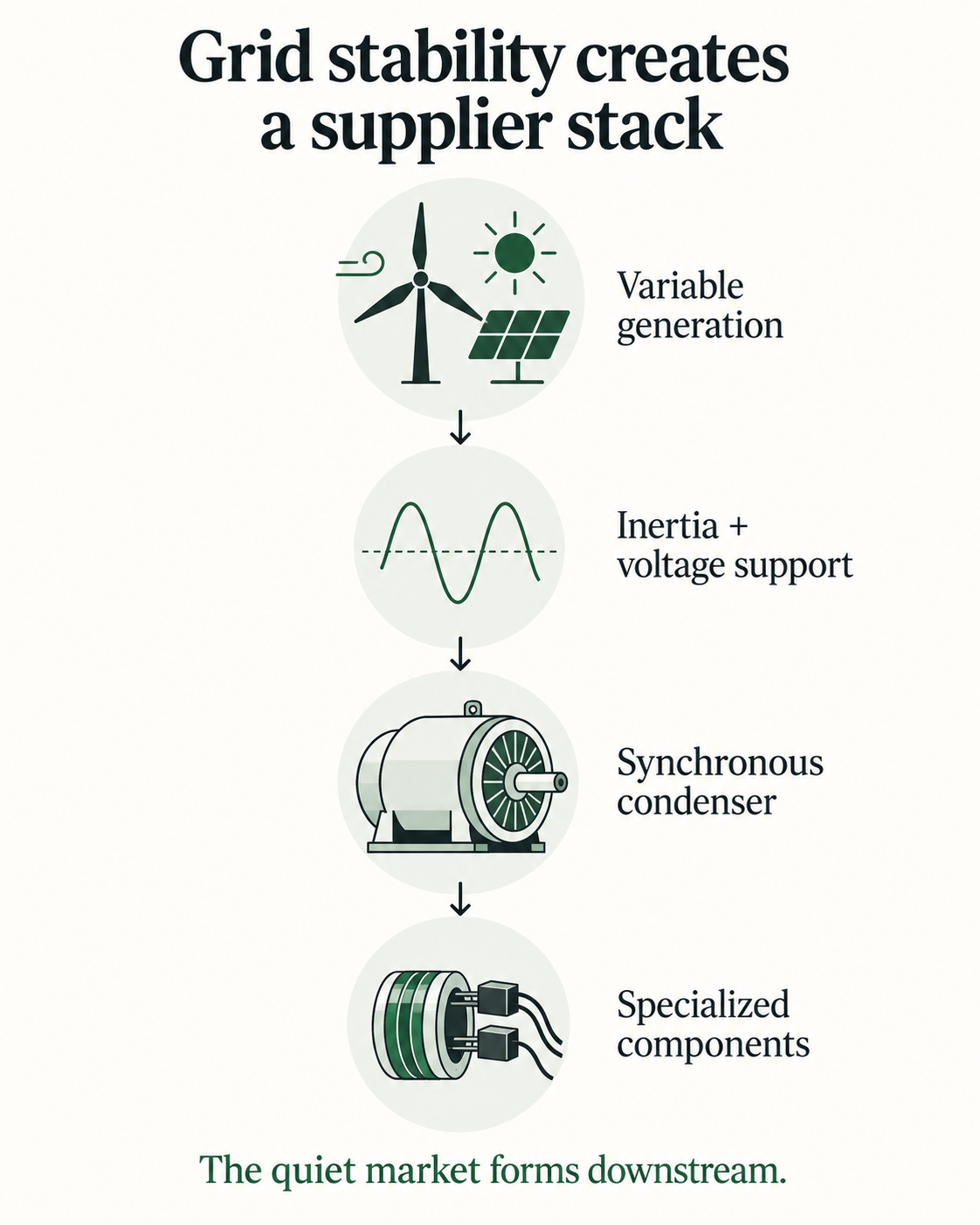
Grid stability is creating a specialized component market downstream of renewables
Middle East & North Africa — Saudi Arabia, with component design and manufacturing in Europe and Brazil
Share ↗
The signal
Mersen's component order for GE Vernova synchronous condensers shows that renewable-grid expansion is pulling demand beyond generation equipment into specialized current-transmission systems needed for inertia and voltage support.
The clue
Mersen has been selected to supply complete current-transmission systems for GE Vernova synchronous condensers serving several Saudi solar and wind projects. Manufacturing is expected to continue through 2028.
Why it matters
Renewable-generation growth creates downstream demand for equipment that maintains voltage and grid inertia. This opens a less-visible market for slip rings, brushes, controls, maintenance and other specialized components—not only turbines, panels and batteries.
Evidence and interpretation
- Observed facts: Mersen says its systems will be designed and tested in France and Austria, with manufacturing support from Brazil. GE Vernova separately confirms it is supplying new synchronous-condensing units in Saudi Arabia. Regional project tracking previously identified multiple renewable sites receiving the equipment. This additional confirmation strengthens a supplier signal first shortlisted on September 25. - Interpretation: An established grid technology is acquiring a renewed, multinational component supply chain as variable generation expands. - Speculation: Similar orders could spread to other renewable-heavy grids. Grid-forming inverters, batteries, flexible demand and transmission upgrades remain competing approaches.
What to watch next
Repeat component orders, disclosed contract scale, factory utilization and commissioned synchronous-condensing capacity would strengthen the thesis; it would weaken if grid-forming inverters, batteries or transmission upgrades satisfy most stability needs without a broader rotating-equipment supplier market.