
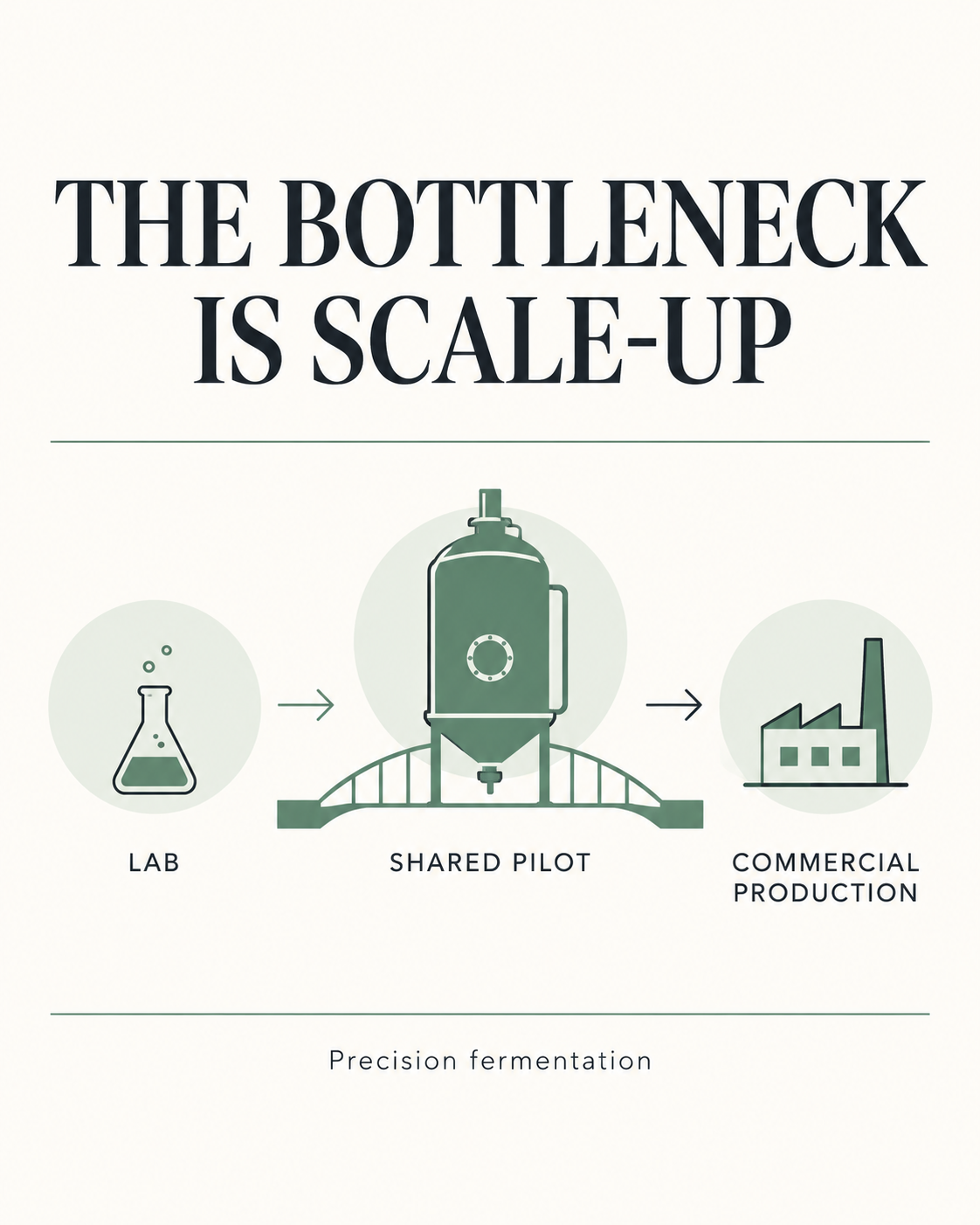
Australia adds a shared bridge from fermentation lab to factory
Oceania — Australia, with relevance to other markets building shared scale-up infrastructure
Share ↗
The signal
Australia's newly accessible food-grade pilot capacity, alongside an operating private demonstration-scale facility, suggests that shared scale-up infrastructure is becoming a distinct commercial layer between laboratory discovery and full production in precision fermentation.
The clue
Australia has opened food-grade pilot capacity to external precision-fermentation projects. The facility connects laboratory work with larger fermentation, purification, drying and quality-control processes—the difficult middle ground before commercial production.
Why it matters
Shared pilot infrastructure could become a business layer of its own. It offers startups and established manufacturers an alternative to building a plant prematurely or moving development offshore, while creating demand for process engineering, validation, downstream processing and contract manufacturing.
Evidence and interpretation
- Observed facts: The QUT Pioneer BioPilot now offers industry access to food-grade fermentation systems ranging from 100 to 2,400 litres and associated downstream processing. A stakeholder submission published through Australia’s national research-infrastructure consultation identified insufficient scale-up capacity as an existing commercialization constraint. Separately, Cauldron Ferm operates food-grade demonstration capacity and is developing a larger commercial facility. - Interpretation: The relevant competitive asset may extend beyond the engineered organism or ingredient to the operational knowledge and infrastructure that reliably transfers a process between vessel sizes. - Speculation: If customer utilization develops, shared pilot plants may evolve into regional scale-up networks serving food, enzymes, chemicals and other biomanufactured products.
What to watch next
Strengthening evidence would be disclosed paid customer programs, high utilization, and products graduating from the pilot line into contracted commercial production; persistent idle capacity, repeated delays, or projects continuing to move offshore would weaken the thesis.