
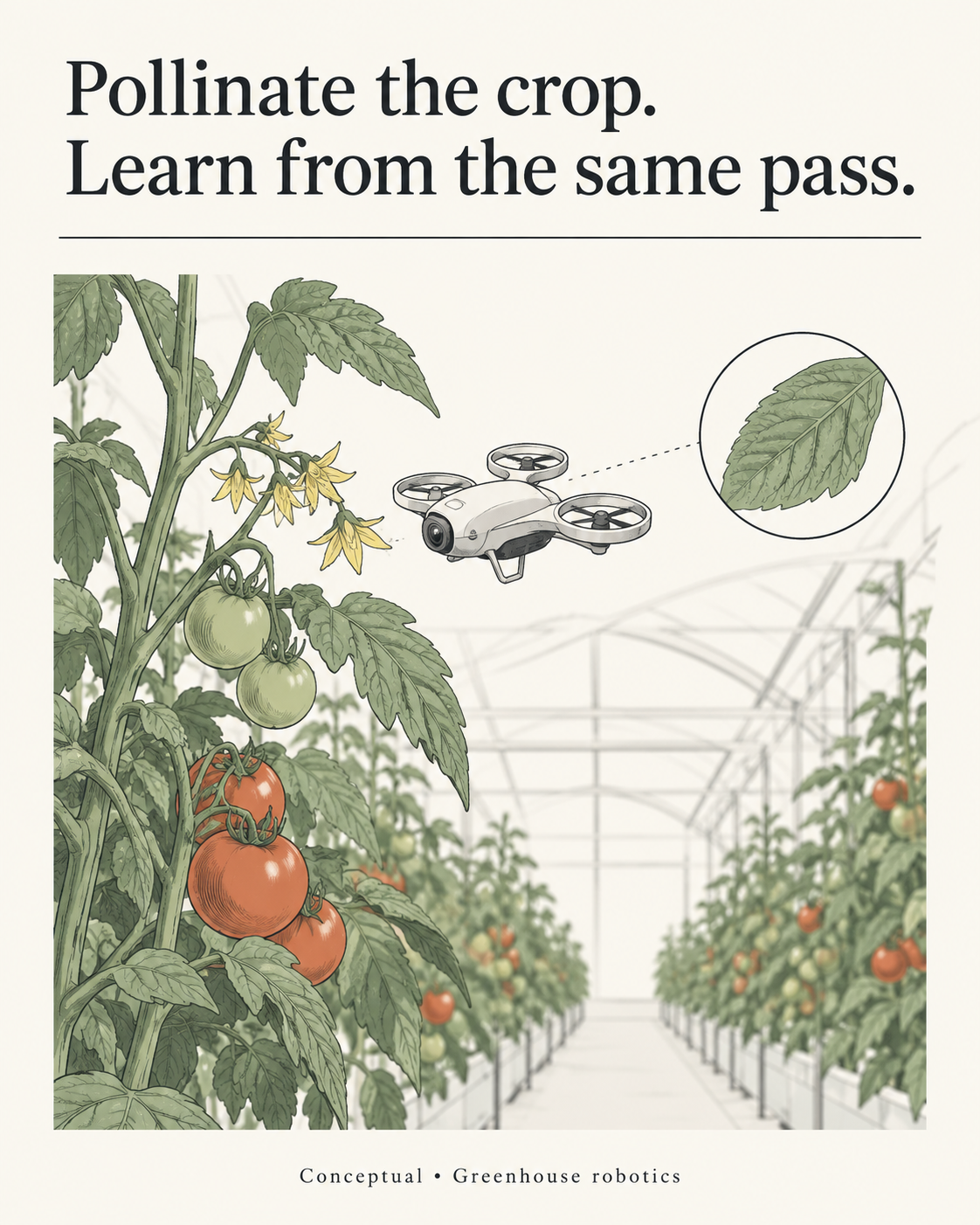
Pollination robots are adding a crop-data service
Oceania — Australia, with Singapore-origin technology and European deployment analogues
Share ↗
The signal
Polybee's September report of commercial greenhouse pollination, its earlier Bayer distribution-and-service partnership, and Arugga's alternative robot-and-data offering suggest crop work can provide a route to recurring crop-intelligence services. Technical and operating performance remains supplier-reported; research support is context, not the initiating clue.
The clue
Pollination equipment is becoming an entry point for crop-observation services. The commercial opportunity may combine a physical task with information gathered while moving through the crop.
Why it matters
Growers could evaluate automation as a recurring service covering crop work, monitoring and support—not simply as a machine purchase. Suppliers would need agronomic expertise and service delivery alongside robotics.
Evidence and interpretation
- Observed facts: In a September 23 account, Polybee’s founder reported commercial pollination operations in Australian glasshouses following crop trials. An earlier July Bayer partnership establishes grower introductions and support, with Polybee delivering a separate farm-intelligence offering. Arugga independently describes commercial greenhouse pollination and crop-data capabilities using ground-based robots. - Interpretation: Flying and ground-based systems point toward the same opportunity: using crop access for more than one function. Bayer’s partnership supports a distribution channel, not proof that every capability runs on one greenhouse pass. These remain interested disclosures, not independently audited economics. - Speculation: Pollination could help pay for recurring crop observation, provided the resulting information changes grower decisions. Manual methods and biological pollinators remain credible alternatives.
What to watch next
Independent whole-season comparisons of labor, supervision, crop performance and total service cost, paid renewals, and forecasts that demonstrably change grower decisions would strengthen the thesis. Unreliable data, excessive supervision or cheaper manual and biological alternatives would weaken it.