
Retail’s next shelf upgrade may be its power supply
East Asia — China and Japan, with Swedish suppliers and a United Kingdom retail pilot
Share ↗
The signal
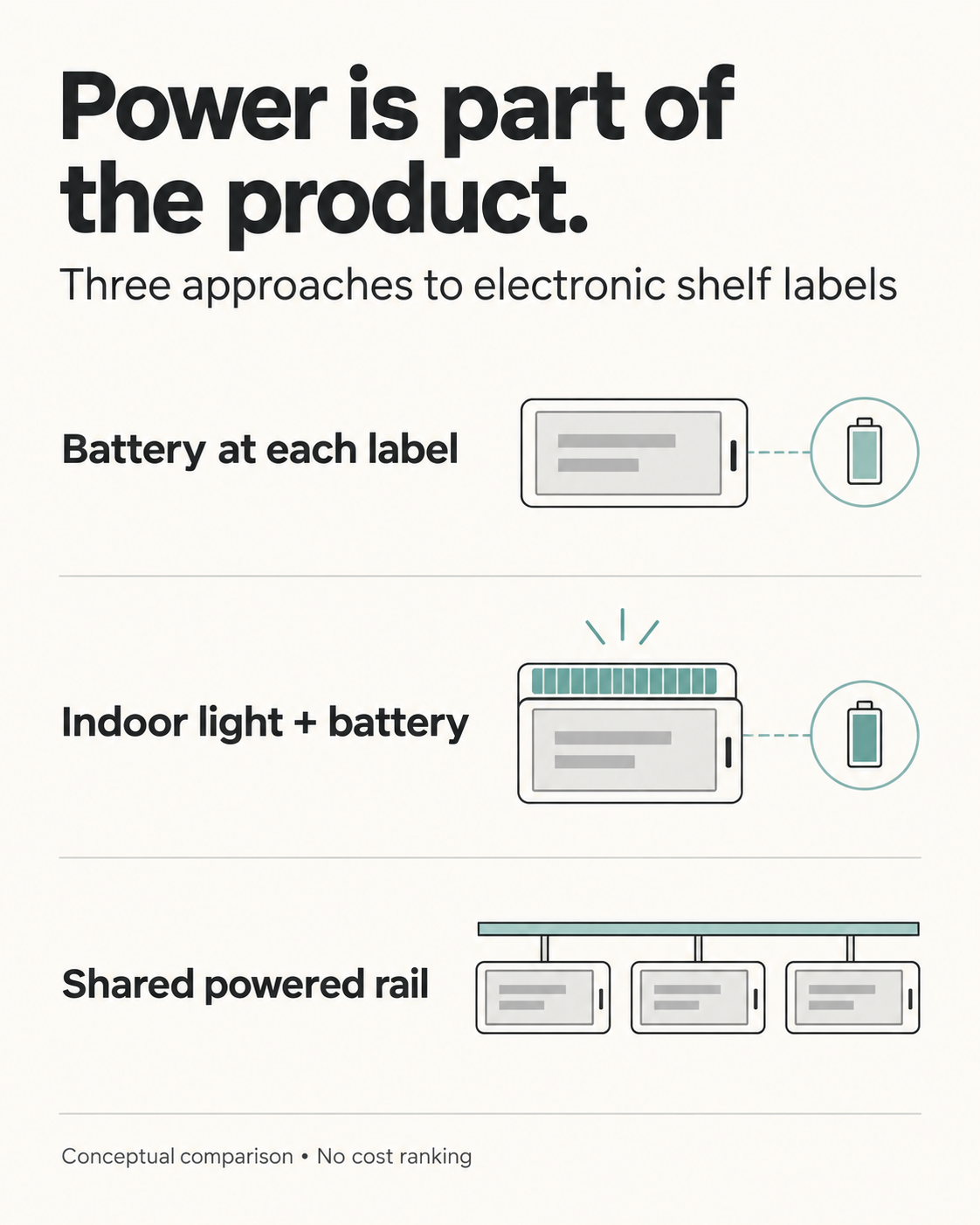
Hybrid light harvesting and shared powered rails suggest shelf-label power architecture is becoming a procurement decision as labels support operational tasks beyond price changes.
The clue
Shelf-label suppliers are exploring different power architectures to support functions beyond changing prices.
Why it matters
Retail buyers may need to evaluate lighting, installation and maintenance alongside the display itself—not assume every electronic label has the same operating model.
Evidence and interpretation
- Observed facts: Hanshow’s September 16 launch combines indoor-light harvesting, a battery and low-power communication for more active shelf functions. Separately, Pricer reported a powered-rail pilot at East of England Co-op on January 7. Light-powered labels are not new: Japan’s Opticon and Sweden’s Epishine demonstrated centralized shelf-level harvesting in January 2024. These are supplier disclosures, not independently verified cost comparisons. - Interpretation: Different suppliers are addressing a common constraint: the energy budget for positioning, picking indicators and richer displays. Conventional batteries, label-level harvesting and shared rails should be compared against the actual store workload. - Speculation: Power-system installation and servicing could become a larger part of shelf-technology contracts.
What to watch next
Paid repeat rollouts, low-light uptime and measured maintenance and installation costs versus conventional battery labels would strengthen the thesis; no operational advantage or excessive retrofit cost would weaken it.